Isothermal reaction
An isothermal reaction is described by a set of ODEs of the form [Sey2009]
\[\begin{split}\begin{equation}
\begin{aligned}
\dot{y_1} &= y_{1}(30 - 0.25y_{1} -y_{2} -y_{3}) + 0.001y_{2}^{2} + 0.1 \\
\dot{y_{2}} &= y_{2}(y_{1} - 0.001y_{2} - \lambda) + 0.1 \\
\dot{y_{3}} &= y_{3}(16.5 - y_{1} -0.5y_{3}) + 0.1
\end{aligned}
\end{equation}\end{split}\]
and the relative stability matrix is therefore:
\[\begin{split}\begin{equation}
\mathbb{A}(\mathbf{x}(t), t) =
\begin{pmatrix}
30 - 0.5y_{1} -y_{2} -y_{3} & y_{1} + 2*0.001y_{2} & -y_{1}\\
y_{2}& y_{1} - 2*0.001y_{2} - \lambda & 0\\
-y_{3} & 0 & 16.5 - y_{1} - y_{3}
\end{pmatrix}
\end{equation}\end{split}\]
Generate the input file containing the ODE system and the hard code the stability matrix, inside
multiflap/odes/isothermal_reaction.py:import numpy as np """ Example case adopted from: Practical Bifurcation and Stability Analysis, page 325 Seydel R. Eq. (7.15) - Isothermal chemical reaction dynamics """ class IsothermalReaction: def __init__(self, lam=1.8): self.lam = lam self.dimension=3 # specify the dimension of the problem def dynamics(self, x0, t): """ODE system This function will be passed to the numerical integrator Inputs: x0: initial values t: time Outputs: x_dot: velocity vector """ y1, y2, y3 = x0 dy1_dt = y1*(30 - 0.25*y1 -y2 -y3) + 0.001*y2**2 + 0.1 dy2_dt = y2*(y1 - 0.001*y2 - self.lam) + 0.1 dy3_dt = y3*(16.5 - y1 -0.5*y3) + 0.1 vel_array = np.array([dy1_dt, dy2_dt, dy3_dt], float) return vel_array def get_stability_matrix(self, x0, t): """ Stability matrix of the ODE system Inputs: x0: initial condition Outputs: A: Stability matrix evaluated at x0. (dxd) dimension A[i, j] = dv[i]/dx[j] """ y1, y2, y3 = x0 A_matrix = np.array([[30 - 0.5*y1 -y2 -y3, y1 + 2*0.001*y2, -y1], [y2, y1 - 2*0.001*y2 -self.lam, 0.], [-y3, 0., 16.5 - y1 - y3]], float) return A_matrix
Generate the main file to run in the directory
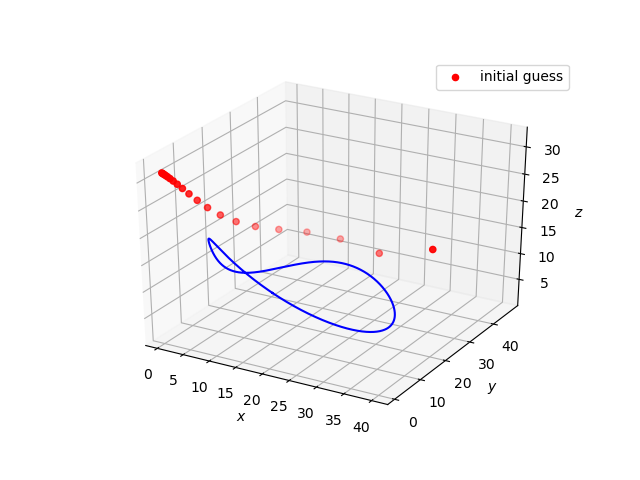
multiflap/main_isothermal.py:import numpy as np from odes.isothermal_reaction import IsothermalReaction from ms_package.multiple_shooting_period import MultipleShootingPeriod import matplotlib.pyplot as plt from ms_package.lma_solver_period import SolverPeriod from mpl_toolkits.mplot3d import Axes3D # generate the ODEs object mymodel = IsothermalReaction(lam=11.) # initial condition x = [40., 20., 20.] # generate the multiple shooting object ms_obj = MultipleShootingPeriod(x, M=20, period_guess=.5, t_steps=200, model=mymodel) # just to plot the initial guess distribution. No need to call this initial_guess = ms_obj.get_initial_guess() # call the solver for the multiple-shooting algorithm mysolution = SolverPeriod(ms_obj=ms_obj).lma() jacobian = mysolution[4] # Floquet multipliers eigenvalues, eigenvectors = np.linalg.eig(jacobian) # ODE limit cycle solution sol_array = mysolution[3].space sol_time = mysolution[3].time period = sol_time[-1] # plot the phase portrait of the limit cycle fig1 = plt.figure(1) ax = fig1.gca(projection='3d') ax.set_xlabel('$x$') ax.set_ylabel('$y$') ax.set_zlabel('$z$') ax.scatter(initial_guess[:,0], initial_guess[:,1], initial_guess[:,2], color='red', label='initial guess') ax.plot(sol_array[:, 0], sol_array[:, 1], sol_array[:, 2],color = 'b') plt.legend() plt.show()
Run the main file inside
multiflapdirectory:python3 main_isothermal.py
the output will look like
- Sey2009
Practical bifurcation and stability analysis, Seydel Rudiger, Springer Science & Business Media