Redox oscillation
The set of ODEs for this system is [DOS2019]:
and the stability matrix:
Generate the input file containing the ODE system and the hard code the stability matrix, inside
multiflap/odes/redox_oscillation.py:class RedoxModel: def __init__(self, a=1000, b=2, c=10000, d=0.2, e=0.1, q=0.1, p=1): self.a = a self.b = b self.c = c self.d = d self.e = e self.q = q self.p = p self.dimension = 4 def dynamics(self, x0, t): """ODE system This function will be passed to the numerical integrator Inputs: x0: initial values t: time Outputs: x_dot: velocity vector """ D1, D2, R, A = x0 dD1_dt = self.p - self.a*A*D1 - self.d*D1 dD2_dt = self.d*D1 - self.e*D2 dR_dt = self.e*D2 - self.q*R dA_dt = self.b*(1-A)*R - self.a*A*D1 vel_array = np.array([dD1_dt, dD2_dt, dR_dt, dA_dt], float) return vel_array def get_stability_matrix(self, x0, t): """ Stability matrix of the ODE system Inputs: x0: initial condition Outputs: A: Stability matrix evaluated at x0. (dxd) dimension A[i, j] = dv[i]/dx[j] """ D1, D2, R, A = x0 A_matrix = np.array([[-self.d - self.a*A, 0., 0.,-self.a*D1], [self.d, -self.e, 0., 0.], [0., self.e, -self.q, 0.], [-self.a*A, 0., self.b*(1-A), -self.b*R -self.a*D1]], float) return A_matrix
Generate the main file to run in the directory
multiflap/redox_main.py:
Import the class generated in the input file RedoxModel and the modules to run and solve the multiple-shooting
from  odes.rossler import RedoxModel
from ms_package.rk_integrator import rk4
from ms_package.multiple_shooting_period import MultipleShootingPeriod
from ms_package.lma_solver_period import SolverPeriod
set the initial guess:
x = [0.5, 0.5, 0.6, 0.2]
Generate the object containing the Rossler’s equations:
mymodel = RedoxModel()
Passe the object to the multiple-shooting class, and solve it
ms_obj =  MultipleShootingPeriod(x, M=2, period_guess= 23., t_steps=50000, model=mymodel)
mysol = SolverPeriod(ms_obj = ms_obj).lma()
`redox_main.py Show full main
import numpy as np
from  odes.redox_oscillation import RedoxModel
from ms_package.rk_integrator import rk4
from ms_package.multiple_shooting_period import MultipleShootingPeriod
from scipy.integrate import odeint
import matplotlib.pyplot as plt
from ms_package.lma_solver_period import SolverPeriod

x = [0.5, 0.5, 0.6, 0.2]

time_array = np.linspace(0, 180, 90000)
mymodel = RedoxModel()

ms_obj =  MultipleShootingPeriod(x, M=2, period_guess= 23., t_steps=50000, model=mymodel)

mysol = SolverPeriod(ms_obj = ms_obj).lma()

jac = mysol[4]

eigenvalues, eigenvectors = np.linalg.eig(jac)


sol_array = mysol[3].space
sol_time = mysol[3].time
period = sol_time[-1]

# Save simulation data
sim_name = 'study_case'
mf.SaveData(sim_name).make_folder()
mf.SaveData(sim_name).save_data('state_space_solution', sol_array)

# Fast plot simulation results
plot = mf.Plot()
plot.limit_cycle_2D(sol_array[:,0], sol_array[:,1])
plot.limit_cycle_3D(sol_array[:,0], sol_array[:,1], sol_array[:,3])
plot.plot_multipliers(eigenvalues)
label = ['D1', 'D2', 'R', 'A']
plot.plot_time_series(sol_array, sol_time, label=label)
The solution is shown below:
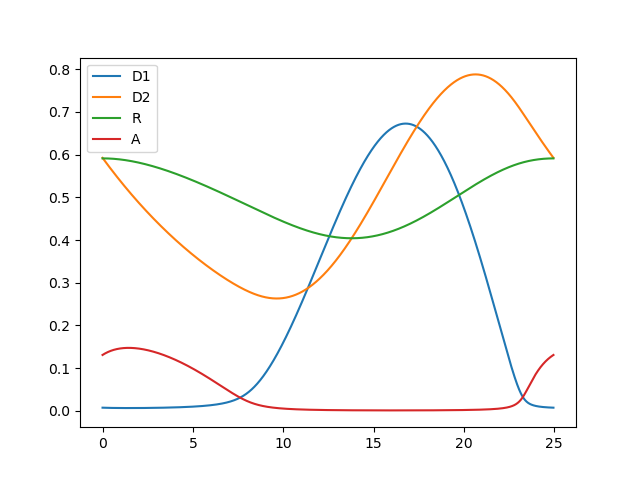
and the value of the stable Floquet multipliers is also plotted:

- DOS2019
del Olmo, M.; Kramer, A.; Herzel, H, A robust model for circadian redox oscillations, Int. J. Mol. Sci. 2019, 20, 2368.